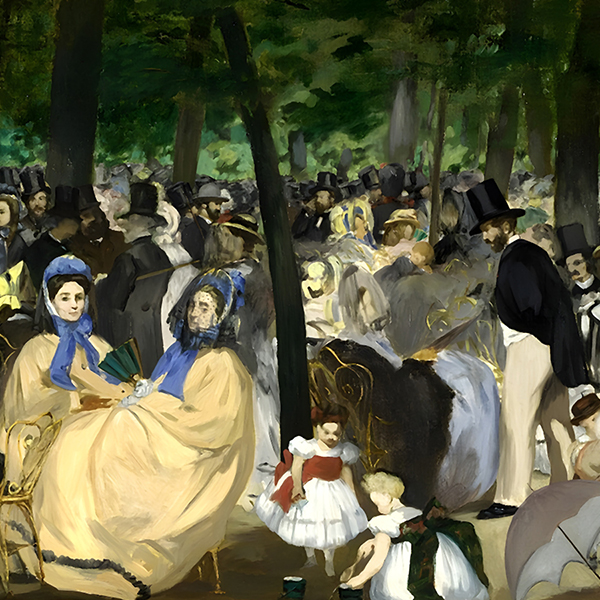
Édouard Manet was born on 23 January 1832 in Paris, France. Considered a precursor of Impressionism, Manet stood out for going against the conventions of the academic painting of his time. His works, which dealt with contemporary themes and scenes of urban life, challenged the aesthetic and social norms of the 19th century.
He studied at the School of Fine Arts in Paris, where he was influenced by artists such as Velázquez and Goya. His painting “Lunch on the Grass” (1863) caused controversy by presenting female nudity in a modern context, moving away from classical ideals. Manet is also known for works such as “Olympia” and “Music in the Tuileries”, which reflect Parisian life and the social changes of the time.
Manet experimented with the use of light and colour in an innovative way, laying the foundations for Impressionism, although he himself did not consider himself part of the movement. Throughout his life, he faced critical resistance, but was eventually recognised as one of the great masters of art, for his audacity and the fundamental importance he played in the evolution of modern painting. He died on 30 April 1883 in Paris.

